


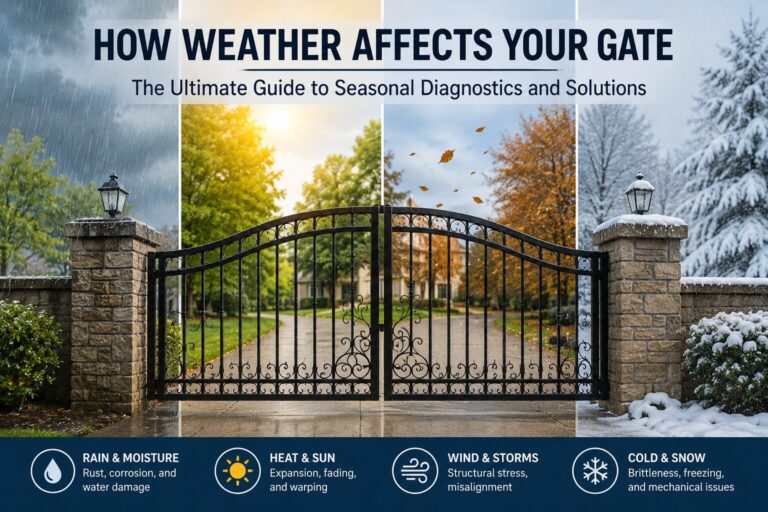
How Weather Affects Gates: Heat, Rain, Wind & Cold
Understanding how weather affects gates can help explain why a driveway gate suddenly becomes difficult to open, starts dragging, will not close completely, reverses unexpectedly, or operates differently during extreme conditions. Heat, moisture, wind, freezing temperatures, and rapid temperature changes can affect the gate structure, hinges, rollers, tracks, operator, batteries, sensors, and other components that keep a gate moving correctly.
For property owners in Dallas–Fort Worth, extreme summer heat, thunderstorms, heavy rain, strong winds, and occasional freezing temperatures can create different stresses on residential and commercial gate systems.
This guide explains how different weather conditions affect driveway and automatic gates, why gates may stick or stop working, what you can safely inspect yourself, and when professional gate diagnostics or repair may be needed.
How Weather Affects Gates: The Quick Answer
Weather can affect both manual and automatic gates. High temperatures can slightly change the dimensions of metal components and expose existing alignment or clearance problems. Moisture can contribute to corrosion and wood swelling. Strong winds can place additional force on swing gates and mounting hardware, while freezing conditions can affect batteries and create ice around moving components.
Understanding how weather affects gates is important because a change in weather can reveal a problem that was already developing. A gate that starts failing during hot, wet, windy, or cold conditions may have poor alignment, worn hinges, damaged rollers, insufficient clearance, a weak battery, sensor trouble, or an operator that is working harder than it should.
Proper diagnostics should identify why the gate's behavior has changed instead of automatically assuming that the motor or operator needs replacement.
Common Signs Weather May Be Affecting Your Gate
Weather-related gate problems can appear gradually or suddenly. Pay attention to whether the symptoms occur only under particular weather conditions.
- A driveway gate becomes harder to open or close during hot weather.
- A metal gate begins rubbing against a post, latch, stop, or another gate panel.
- A gate works normally in the morning but begins sticking later in the day.
- A wooden gate swells, drags, twists, or becomes difficult to latch.
- An automatic gate begins moving more slowly.
- The gate stops before reaching the fully open or fully closed position.
- An automatic gate reverses unexpectedly.
- A sliding gate starts scraping, binding, or moving unevenly.
- A swing gate begins sagging or moving differently.
- A remote, keypad, intercom, or access-control device becomes unreliable.
- Rust develops around hinges, welds, brackets, or fasteners.
- The gate changes behavior after heavy rain, strong wind, extreme heat, or freezing weather.
Weather-Related Gate Troubleshooting Guide
| Gate Symptom | Possible Weather-Related Factor | What to Inspect |
|---|---|---|
| Gate sticks in hot weather | Thermal expansion or already-tight clearance | Frame, hinges, latch, stops, and alignment |
| Metal gate rubs against a post | Heat combined with alignment or structural movement | Posts, hinges, mounting points, and clearances |
| Wooden gate becomes difficult to close | Moisture absorption, humidity, or warping | Wood panels, frame, hinges, and clearance |
| Automatic gate moves slowly | Mechanical resistance or electrical issue | Hinges, rollers, track, operator, and power supply |
| Gate reverses while closing | Obstruction, resistance, or safety-device issue | Photo eyes, safety devices, track, and gate movement |
| Gate becomes unreliable after rain | Moisture, corrosion, or electrical exposure | Operator enclosure, wiring, controls, and hardware |
| Swing gate moves excessively in wind | Wind load | Gate panel, hinges, posts, operator arms, and mounts |
| Gate stops responding in cold weather | Battery performance, ice, or mechanical resistance | Battery, power, hinges, rollers, track, and operator |
How Hot Weather Affects Gates and Driveway Gate Operation
One of the most important parts of understanding how weather affects gates in North Texas is recognizing what happens during extreme summer temperatures.
A gate system contains several materials and mechanical components that can respond differently as temperatures rise throughout the day.
Metal expands when heated. On a properly designed and aligned gate, the dimensional change is normally small enough that the gate continues operating correctly. Problems become more noticeable when the gate is already tightly fitted, slightly misaligned, sagging, rubbing, or placing excessive resistance on the automatic operator.
This can explain why a driveway gate sometimes works normally during cooler morning temperatures but begins sticking or rubbing during the hottest part of the afternoon.
Why Does My Gate Get Stuck When It Is Hot?
A gate that becomes difficult to move during high temperatures can have several possible causes:
- Small changes in metal dimensions reduce already-tight clearance.
- Gate posts or mounting points are slightly out of alignment.
- Hinges are worn, dry, damaged, or carrying uneven weight.
- A swing gate is sagging.
- Sliding-gate rollers or wheels are worn or binding.
- The sliding track contains debris or has alignment problems.
- Operator arms, chains, brackets, or mounting hardware are under excessive load.
- The gate structure has already shifted or warped.
If the problem repeatedly occurs during periods of extreme heat, compare how the gate moves during cooler temperatures. A consistent temperature-related pattern can provide useful information during professional gate diagnostics.
Why Is My Gate Hard to Open in Summer?
Do not automatically assume that the gate motor has failed because an automatic gate is struggling to open.
The operator still has to move the physical gate. If the gate is dragging, binding, sagging, rubbing, or experiencing excessive resistance, the operator must work harder during every cycle.
Repeatedly forcing an automatic gate to move while it is mechanically restricted can increase stress on the system. The gate structure and movement should therefore be inspected along with the operator and controls.
Do Metal Gates Expand in Heat?
Yes. Metal expands as its temperature increases. For a driveway gate, however, the important issue is whether the system has enough clearance and whether its frame, hinges, posts, rollers, track, and operator remain properly aligned.
A small dimensional change may go unnoticed on a properly operating gate but become noticeable on a system that already has very little clearance.
Signs Heat May Be Exposing a Metal Gate Alignment Problem
- The gate rubs against the receiving post.
- Two gate leaves contact each other before fully closing.
- A latch no longer aligns consistently.
- The gate begins scraping against the driveway.
- The gate opens normally when cool but binds during hotter periods.
- The automatic operator slows or stops at the same point during travel.
These symptoms do not necessarily mean that heat alone caused the problem. They can also indicate sagging hinges, shifting posts, structural movement, damaged hardware, or improper adjustment.
A complete gate inspection is usually more useful than simply adjusting the automatic operator to compensate for a mechanical problem.
How Weather Affects Gates Made From Wood
When considering how weather affects gates, wooden gates require different attention than steel or iron gates.
Moisture and humidity can cause wood to absorb water and change dimension. Extended hot and dry conditions can also contribute to drying, shrinking, checking, cracking, or warping depending on the type of wood, construction, finish, and exposure.
If a wooden driveway gate becomes difficult to close after rain or during humid weather, moisture-related swelling may be reducing the available clearance.
Signs of Weather Stress on a Wooden Gate
- Wood panels appear swollen or distorted.
- The gate begins dragging against the ground.
- The gate no longer meets the post or opposite gate leaf correctly.
- The latch becomes difficult to engage.
- Paint or protective coating begins peeling or cracking.
- The wood shows cracking, splitting, twisting, or other visible movement.
Before trimming or permanently modifying a swollen wooden gate, determine whether the condition may be temporary and moisture-related. Removing material while the wood is swollen can create excessive gaps when the wood dries.
How Weather Affects Automatic Gates and Gate Openers
An automatic gate is a complete system, not simply a motor. Proper operation depends on the physical gate moving freely and on the operator, power supply, batteries, control board, limits, safety equipment, receivers, keypads, intercoms, and other connected components operating correctly.
Extreme weather can make an existing mechanical or electrical problem more noticeable even when weather was not the original cause.
Automatic Gate Components Worth Checking
- Gate movement: Does the gate drag, bind, scrape, sag, or move unevenly?
- Hinges: Are they loose, worn, damaged, or creating excessive resistance?
- Rollers and wheels: Do sliding-gate components move smoothly?
- Track: Is the track straight, secure, and clear of debris?
- Chains and operator arms: Are mounting points secure and correctly aligned?
- Operator: Does it sound different, stop unexpectedly, or struggle during travel?
- Battery and power: Is the system receiving reliable power?
- Photo eyes and safety equipment: Are they clean, aligned, and unobstructed?
- Access controls: Are remotes, keypads, receivers, or intercoms responding normally?
Everlast Gates & Fence provides automatic gate repair, service, and installation for residential and commercial gate systems throughout Dallas–Fort Worth.
Why Does My Automatic Gate Reverse Unexpectedly?
An automatic gate that begins closing and then reverses may be encountering physical resistance or receiving a signal from part of the safety system.
Possible causes include:
- An obstruction in the gate path.
- Gate misalignment.
- Binding hinges or rollers.
- A sliding-gate track problem.
- Photo-eye alignment or obstruction.
- A loop or other safety-device issue.
- Operator settings or adjustments.
Never bypass an automatic gate safety device simply to keep the system operating. Repeated reversing should be correctly diagnosed.
Why Does My Gate Work in the Morning but Stick in the Afternoon?
If a gate operates normally during cooler morning temperatures but begins rubbing, binding, or stopping during the hottest part of the day, changing temperatures may be reducing available clearance somewhere in the system.
Look for:
- Tight spacing between double gate leaves.
- Contact between the gate and receiving post.
- Scraping near the bottom of a swing gate.
- A sliding gate binding at one particular point.
- Operator strain near the same position during every cycle.
Recording when the problem occurs can help a gate technician distinguish a temperature-related issue from an intermittent electrical or access-control problem.
How Rain and Moisture Affect Gates
Rain creates a different group of potential problems. Moisture can affect structural materials, exposed hardware, electrical equipment, and even the ground surrounding gate posts.
Rust and Corrosion on Metal Gates
Protective coatings help isolate steel from moisture, but scratches, chipped paint, damaged weld areas, exposed fasteners, and worn surfaces can allow corrosion to begin.
Inspect areas such as:
- Hinges and pivot points.
- Welded joints.
- Lower portions of the gate exposed to standing water or irrigation.
- Operator brackets and mounting hardware.
- Chains and other exposed metal components.
- Areas where protective coating has chipped or worn away.
Can Rain Cause an Automatic Gate to Stop Working?
A properly installed automatic gate system should be designed for outdoor conditions. However, water intrusion, damaged seals, deteriorated wiring, compromised enclosures, corrosion, or drainage problems can contribute to failures.
If a gate becomes unreliable specifically after heavy rain, note whether the issue affects:
- The gate operator.
- Remote controls.
- Keypads.
- Intercom equipment.
- Photo eyes.
- Vehicle loops.
- Other gate access-control components.
If you see damaged wiring, standing water around electrical equipment, burning, arcing, or other electrical concerns, stop operating the system and have it inspected.
How Wind and Storms Affect Driveway Gates
Strong wind can place significant force on a driveway gate, particularly a large swing gate or a gate with a solid or semi-solid surface.
Repeated wind loading can place additional stress on:
- Gate hinges.
- Posts and columns.
- Automatic gate operator arms.
- Brackets and mounting points.
- Welds and gate frames.
- Stops and latching hardware.
What Should You Check After a Strong Storm?
After severe weather, visually inspect the gate before repeatedly cycling it.
- Look for fallen branches or debris in the gate path.
- Check whether the gate still appears level and aligned.
- Inspect hinges and visible mounting hardware.
- Check sliding-gate tracks for debris.
- Look for damage around operator arms or brackets.
- Confirm that photo eyes and other safety devices have not been moved or blocked.
If the gate appears bent, unstable, off-track, or structurally damaged, avoid forcing it through another automatic cycle.
How Cold Weather and Freezing Temperatures Affect Gates
Dallas–Fort Worth does not experience prolonged freezing weather every winter, but periods of low temperatures can still affect gate operation.
Cold-weather problems can include:
- Reduced battery performance.
- Ice or frozen moisture interfering with moving components.
- Debris freezing around tracks or rollers.
- Existing mechanical resistance becoming more noticeable.
- Water intrusion that becomes problematic as temperatures fall.
- Changes in material dimensions and clearances.
Why Is My Automatic Gate Slow When It Is Cold?
A slow automatic gate can have mechanical or electrical causes. Check for visible ice, debris, track obstruction, dragging, or unusual resistance.
If the physical gate moves poorly, forcing the operator to continue cycling may increase the load on the system.
If there is no obvious obstruction and the problem continues, the battery, power supply, operator, controls, or mechanical components may require professional diagnostics.
Weather-Related Gate Diagnostic Checklist
Knowing how weather affects gates is easier when you record what happens before, during, and after a malfunction.
1. Identify When the Problem Happens
- Only during extreme afternoon heat?
- Immediately after rain?
- During or after strong winds?
- Only during freezing temperatures?
- During every cycle or only occasionally?
2. Watch the Entire Gate Cycle
Without entering the moving gate's path, observe whether the problem occurs at the beginning, middle, or end of travel.
Watch and listen for:
- Dragging.
- Scraping.
- Uneven movement.
- Hesitation.
- Stopping.
- Unexpected reversing.
- Unusual shaking.
- Grinding, clicking, or scraping noises.
3. Inspect the Physical Gate
- Are the posts upright?
- Does the gate appear level?
- Are the hinges secure?
- Are both gate leaves meeting correctly?
- Does anything appear bent or loose?
- Is the sliding-gate track clean?
- Are rollers or wheels visibly damaged?
4. Check for Safe and Obvious Obstructions
Leaves, stones, branches, mud, ice, and other debris can interfere with gate movement or safety equipment. Remove only objects that can be cleared safely without entering dangerous moving areas or opening electrical equipment.
5. Check Gate Safety Sensors Visually
Make sure photo eyes and other visible safety components are not covered by mud, vegetation, debris, or obvious damage.
6. Record the Problem
A short video showing the symptom, approximate temperature, recent weather conditions, and where during the cycle the gate fails can provide valuable diagnostic information.
When Does a Weather-Related Gate Problem Need Repair?
Some problems can be resolved by clearing debris or removing an obvious obstruction. Other symptoms may indicate a mechanical, structural, electrical, operator, or access-control problem that should be professionally inspected.
Consider scheduling gate diagnostics when:
- The gate repeatedly fails to open or close completely.
- The gate is visibly sagging or misaligned.
- A sliding gate has come off its track.
- The automatic operator repeatedly stops or reverses.
- The motor appears to struggle while moving the gate.
- Hinges, brackets, posts, or welds appear damaged.
- The problem returns whenever temperatures increase.
- The system becomes unreliable after rain.
- A remote, keypad, intercom, or safety device stops responding.
- There is visible electrical damage or water around electrical equipment.
- The gate cannot be operated safely.
Everlast Gates & Fence provides gate repair and installation services and can evaluate the physical gate, operator, structural hardware, power, safety equipment, and access controls rather than assuming every malfunction is simply an operator problem.
How to Prevent Weather-Related Gate Problems
You cannot control the weather, but routine inspection and maintenance can help identify conditions that make a driveway gate more vulnerable to heat, moisture, storms, and freezing temperatures.
Keep the Gate Path Clear
Remove leaves, mud, stones, branches, and other debris from sliding tracks and areas where the gate travels.
Watch for Changes in Gate Alignment
Do not ignore a gate that gradually begins rubbing, scraping, sagging, or closing unevenly. Even small alignment changes can increase mechanical resistance.
Protect Exposed Metal
Address damaged coatings, exposed steel, and developing corrosion before rust spreads across structural or moving components.
Maintain Moving Gate Components
Hinges, bearings, rollers, chains, and other moving components should be maintained according to their design and manufacturer requirements.
Keep Water Away From Gate Equipment
Standing water around gate operators, posts, tracks, conduits, or access-control equipment can create avoidable problems. Property drainage and irrigation should not continually direct water toward sensitive gate equipment.
Have Recurring Problems Diagnosed
A gate that repeatedly fails under the same weather conditions is providing an important diagnostic clue. Instead of continuously resetting the system or changing operator adjustments, identify the underlying source of the resistance or control problem.
How Weather Affects Gates in Dallas–Fort Worth
Understanding how weather affects gates in Dallas–Fort Worth is particularly important because local gate systems can experience extreme summer temperatures, thunderstorms, heavy rain, strong winds, and occasional winter freezes.
These conditions make proper gate alignment, structural support, electrical protection, safety equipment, and operator setup important for reliable operation.
Everlast Gates & Fence works with residential and commercial gate systems throughout the Dallas–Fort Worth Metroplex, including swing gates, sliding gates, driveway gates, automatic gate operators, and access-control equipment.
If your gate becomes unreliable during particular weather conditions, a complete diagnostic inspection can help determine whether the problem is structural, mechanical, electrical, operator-related, or connected to the access-control system.
Frequently Asked Questions About How Weather Affects Gates
Do metal gates expand in hot weather?
Yes. Metal expands as temperature rises. Normally the dimensional change is small, but on a long gate or a system with very tight clearance, an existing alignment problem can become more noticeable during extreme heat.
Why does my driveway gate get stuck when it is hot?
A gate that sticks during hot weather may have insufficient clearance, alignment problems, sagging hinges, worn rollers, track issues, structural movement, or another source of mechanical resistance. Heat-related expansion can make an existing tight-clearance problem more noticeable.
Why does my gate work in the morning but not in the afternoon?
If a gate works correctly during cooler hours but begins binding during the hottest part of the day, changing temperatures may be affecting clearances in a system that is already tightly fitted or slightly misaligned.
Can a wooden gate swell in hot weather?
Moisture and humidity are typically more important causes of wood swelling than heat itself. Hot and dry conditions can also cause wood to dry, shrink, crack, or warp.
Can extreme heat affect an automatic gate opener?
Automatic gate equipment is designed for outdoor operation within specified conditions, but extreme temperatures can expose problems involving power, batteries, operator load, electronics, or mechanical gate movement.
Can rain cause an electric gate to stop working?
Rain should not disable properly protected outdoor gate equipment, but water intrusion, damaged seals, compromised wiring, corrosion, drainage problems, or damaged electrical components can contribute to failures.
Why does my automatic gate reverse before closing?
Unexpected reversing can result from an obstruction, excessive mechanical resistance, alignment problems, track issues, photo-eye conditions, safety devices, or operator settings. Do not bypass safety equipment to stop the reversing behavior.
Can strong winds damage an automatic swing gate?
Strong wind places additional force on swing gates, particularly large gates with significant surface area. That force can stress hinges, posts, operator arms, brackets, mounting points, and the gate frame.
Can freezing weather affect a driveway gate?
Yes. Freezing temperatures can affect batteries and may cause collected moisture to freeze around moving components. Ice, debris, existing mechanical resistance, or electrical issues can also contribute to unreliable operation.
Should I keep using my automatic gate if it is struggling to move?
If the gate is dragging, binding, off-track, visibly damaged, or the operator repeatedly stops, avoid continuously forcing it through additional cycles. The resistance may indicate a problem with the physical gate or automatic operator system that should be diagnosed.
Need Help With a Gate That Changes With the Weather?
If your driveway gate starts sticking during summer heat, stops working after rain, changes movement after a storm, or becomes unreliable during freezing conditions, the problem should be evaluated as part of the complete gate system.
Everlast Gates & Fence provides gate diagnostics, repair, automatic gate service, gate installation, and access-control services for residential and commercial properties throughout Dallas–Fort Worth.
Request Gate Service From Everlast Gates & Fence
Call or text: 234-GATEPRO (234-428-3776)
Learn more about automatic gate services, gate repair and installation, and access-control systems.
