


Hot dip galvanized structural steel thicker than one quarter inch can reach 72 to 73 years before first maintenance, even in an industrial atmosphere. That figure does not promise the same life for every fence. However, it shows why posts, hinges, bolts, and protective coatings may matter as much as the visible iron panels.
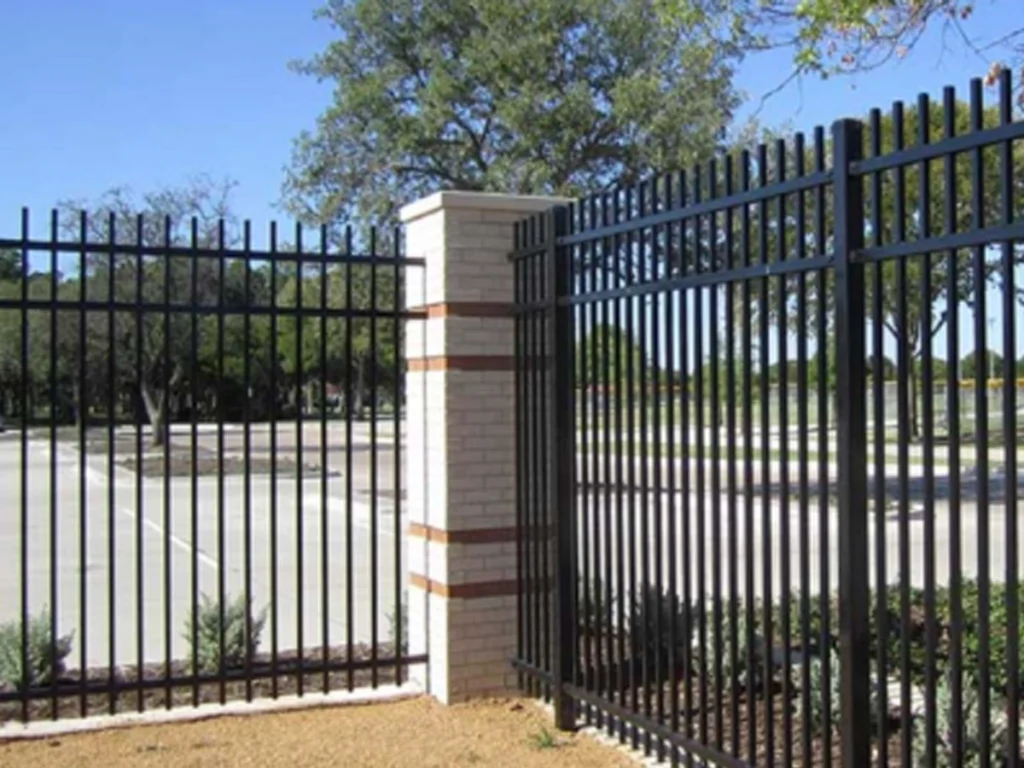
Iron Fence Posts and Hardware
Iron fence posts and hardware should match the fence height, panel weight, gate size, soil, finish, traffic, and local rules. Line posts support straight sections. Corner and end posts manage changing or stopping loads. Meanwhile, gate posts carry moving weight and repeated force. Therefore, they often need more support.
Hardware must also work as one system. Hinges need a suitable published rating and useful adjustment. Latches must fit the entrance. Fasteners should match the metal and coating. Stops, caps, brackets, rods, and locks should suit the expected use.
- First, choose the complete fence and gate system before setting post spacing.
- Next, require a written scope naming post sizes, footings, hardware, finish, and installation duties.
Start With the Real Purpose of the Iron Fence
Choosing iron fence posts and hardware begins with one question. What must the fence do each day? A decorative front fence has different needs from a pool barrier, commercial boundary, pet enclosure, or driveway entrance.
Therefore, decide the goal before comparing parts. Height, openness, gate width, and security needs all change the load. For example, a walk gate may open several times daily. A business gate may handle far more cycles. Meanwhile, a wide driveway gate creates greater force at its hinge post.
The design also affects wind. Open pickets let more air pass than dense metal inserts. However, plates and privacy panels can increase wind load.
- Record the fence purpose, height, panel style, gate widths, and expected use.
- Identify needs involving children, pets, pools, vehicles, accessibility, privacy, or automation.
For wider planning, review this guide to iron fence installation in Plano.
Give Every Post the Right Structural Job
Not every post performs the same job. A line post keeps adjoining panels aligned. An end post finishes a run and resists load from one direction. Meanwhile, a corner post manages forces from two fence lines.
Most importantly, gate posts carry the gate, hinges, latch force, and repeated motion. They may also support a closer, operator arm, electric lock, or access device. Therefore, a standard line post should not be assumed suitable for a heavy gate.
A clear post schedule can list each location, outside size, wall thickness, length, finish, cap, footing, and attached hardware.
- Label line, end, corner, transition, and gate posts on the layout.
- Place added strength where the actual structural and operating loads occur.
Choose Post Size From Height, Load, and Exposure
A larger outside dimension does not alone prove that a post is stronger. Wall thickness, steel grade, length, weld details, and footing support also matter. Therefore, request the relevant dimensions in the proposal.
Taller fences usually create more leverage at ground level. Close picket spacing and decorative parts can add weight. In addition, exposed locations may face more wind than sheltered yards.
Gate posts need separate review. The hinge post resists vertical weight and twisting force. The latch post receives closing impact and keeps the opening aligned. If an operator may be added later, plan for that force now.
- Require the post outside size, wall thickness, length, and finish in writing.
- Ask the installer to explain why each gate post fits the proposed gate.
Do not rely on the word iron alone. Ask the supplier to name the actual metal and fabrication method. This guide to choosing gate fabrication materials adds useful context.
Set Spacing From the Chosen Panel System
Generic spacing rules can cause costly errors. Prefabricated panels have fixed widths, bracket allowances, and installation clearances. Custom welded panels also need measured openings. Therefore, establish spacing from the actual system.
One manufacturer guide shows why small differences matter. Its instructions list different on center spacing for two inch posts and two and one half inch posts. That example applies only to that product.
Corners and slopes add variables. A stepped fence may need shorter panels. Masonry columns can also reduce the usable opening unless brackets and caps are planned early.
- Obtain the panel drawing and bracket details before marking holes.
- Measure each gate opening after hinge and latch allowances are known.
A planned custom final bay is usually better than forcing a standard panel into an uneven space.
Build Footings for the Actual Site and Load
A strong post can lean when its footing does not fit the site. Soil, drainage, slope, roots, paving, and gate force all influence footing design. Therefore, no single depth or diameter suits every iron fence.
Gate posts often need more support because they carry moving loads. Likewise, tall corner posts can receive more leverage. A post beside a driveway may also face impact risk.
Drainage deserves attention. Water around a footing can soften soil and support movement. The installer should also protect exposed steel near the concrete line because that area receives moisture.
- State footing size, concrete work, and post setting methods in the written scope.
- Review slopes, drains, irrigation, roots, paving, and retaining walls before digging.
Plano asks for footing information when certain masonry fences or columns are proposed. It also requires drawings and inspections for applicable work.
Select Hinges by Gate Weight and Daily Use
Hinges carry a gate throughout its working life. Therefore, choose them from finished gate weight, width, expected cycles, wind exposure, and mounting method. Decorative appearance should follow safe capacity.
Ask whether a published rating assumes two hinges or another arrangement. Also, confirm the gate frame and post are strong around each attachment point. A strong hinge cannot correct a weak frame or flexible post.
Adjustment is valuable because gates can settle. An adjustable hinge may restore the gap without new welding. Bearings or bushings may reduce friction on gates that move often.
- Ask for the hinge model, rated capacity, quantity, and mounting method.
- Confirm that adjustment, lubrication, and future replacement remain practical.
For design ideas, review modern iron gate trends in Plano.
Match Latches, Stops, and Locks to the Entrance
A latch should fit the user, traffic, and security goal. A yard gate may need a simple mechanical latch. A controlled entrance may require a keyed lock, electric strike, magnetic lock, keypad, or intercom connection.
However, the lock is only one part. The latch post must stay firm, and the gate gap must remain within the hardware range. A stop should absorb closing force when the latch was not designed for repeated impact. Double gates may also need drop rods and firm receivers.
Commercial pedestrian gates may need accessible operation. Federal guidance generally requires hardware on an accessible route to work with one hand, without tight grasping, pinching, or wrist twisting.
- Choose hardware after deciding who will use the gate and how entry will work.
- Check handle height, closing force, stops, rods, emergency use, and access needs.
Plano directs owners to special pool and spa barrier rules. Therefore, verify current closing and latching requirements for any pool gate.
Match Fasteners, Brackets, Coatings, and Care
Small fasteners can decide whether a fence stays tight. Bolts, screws, nuts, washers, and brackets need suitable strength, length, thread engagement, and corrosion protection.
Metal compatibility also matters. Moisture can support galvanic corrosion when dissimilar metals touch. Therefore, review the fastener, bracket, and base metal together.
The American galvanizes Association explains that unprotected fasteners can corrode and lose integrity. It recommends hot dip galvanized fasteners with hot dip galvanized assemblies. It also notes that hot dip galvanizing gives full coverage and a thicker zinc layer than simple zinc plating.
- Match fastener protection with the post, panel, bracket, and outdoor exposure.
- Repair coating damaged by drilling, cutting, welding, impact, or later adjustment.
Plan Early for a Future Automatic Gate
A manual driveway gate may later receive an operator. Therefore, early planning can prevent major changes. Gate posts, hinge geometry, stops, travel space, power, controls, and safety devices should be considered before concrete cures.
An operator does not make a weak gate strong. Instead, repeated motor force can reveal poor alignment, loose hinges, or flexible posts. The manual gate should move freely and stop correctly first.
- Tell the contractor about future operators, access control, and intercom plans.
- Reserve safe space for movement, controls, safety devices, power, and service.
Read the ultimate guide to iron gate installation for more planning context.
Check Plano Rules Before Ordering Posts
Local rules can change the post layout and gate design. Plano’s online handout states a general maximum fence height of eight feet. It limits fences in a required front yard to 40 inches and requires at least 50 percent openness there. Corner lots also have sight visibility rules.
The handout says sliding gates must sit inside the fence line, not on the alley side. Gates may not enter city right of way. Applicable submitting can include a site plan, elevations, and footing details. Homeowner association rules may add limits.
Use the City of Plano residential permit resources before final design because requirements can change.
- Verify property lines, easements, front yard limits, gate travel, and sight areas.
- Obtain required city and homeowner association approval before ordering steel.
Early review can prevent a finished gate from opening into a prohibited area.
Three Honest Planning Scenarios
The supplied brief asks for case studies, but it provides no verified customer project records. Therefore, these are planning scenarios, not claims about completed Everlast projects.
A low front fence may use standard panels and one walk gate. Yet its gate posts still need separate review. Plano front yard rules may also affect height and openness.
A taller fence on a slope may need stepped or racked panels. Post lengths and openings can change across the run. Drainage and soil movement also need attention near low areas.
A driveway gate prepared for automation needs firm posts, rated hinges, stops, and clear travel space. Early power and safety planning can prevent later rebuilding.
- Use these scenarios as discussion guides, not universal specifications.
- Base final dimensions and hardware on the measured and approved site.
Compare Written Quotes With a Clear Checklist
Two proposals can show the same fence length but include different support systems. Therefore, compare exact details rather than the bottom line alone.
The post section should list outside size, wall thickness, type, spacing, finish, cap, and footing. The panel section should list height, width, rails, picket spacing, brackets, and weld details. The gate section should list frame construction, hinges, latch, stop, lock, and adjustment method.
The scope should also assign permits, utility notice, removal, disposal, coating repair, cleanup, and inspections. It should explain how changes receive approval.
- Reject vague phrases such as standard posts or heavy hardware without details.
- Compare warranty terms, exclusions, care duties, and change rules in writing.
This guide on modern welding methods for Plano gates explains why fabrication and finish repair belong together.
14. Choose a Plano Contractor Who Reviews the Whole System
A professional review should begin with measurements and site conditions. It should connect the fence purpose with post duties, gate loads, hardware, finish, drainage, and local rules.
A practical professional view is simple. Posts, footings, hinges, latches, and fasteners should be treated as one system rather than separate shopping items.
Everlast Gates & Fence lists residential and commercial fencing, driveway gates, custom gates, access control, intercom work, and repair among its Plano services.
- Ask for a measured layout and a written post and hardware schedule.
- Confirm that fabrication, setting, coating repair, and gate adjustment form one plan.
Strong iron fence posts and hardware are not hidden extras. They are the working foundation of the fence.
Frequently Asked Questions
What type of posts are best for an iron fence?
The best post depends on fence height, panel weight, spacing, wind, soil, and location. Line, corner, end, and gate posts perform different jobs. Therefore, the proposal should name the outside size, wall thickness, length, finish, and footing for each post type instead of using one vague standard.
How deep should iron fence posts be?
There is no safe universal depth for every iron fence. Required depth depends on soil, drainage, post size, fence height, wind, slope, and gate load. Therefore, follow the selected fence system, local requirements, and a site based plan. Gate posts and masonry columns may need added support or footing details.
How far apart should iron fence posts be?
Post spacing should follow the panel width, brackets, post dimensions, corner layout, and grade. Manufacturer instructions can vary even when post sizes change slightly. Therefore, measure the chosen system before digging. Custom panels need verified openings, while gates require separate hinge and latch allowances.
What hinges are best for a heavy iron gate?
Choose hinges with a published capacity suited to the finished gate and proposed arrangement. The installer should consider weight, width, daily cycles, wind, frame strength, and post support. Adjustable hinges can help alignment, while bearings may reduce friction. However, the exact model must fit the complete gate system.
How can iron fence hardware be protected from rust?
Start with compatible metals and a coating suited to outdoor use. Choose protected fasteners that match the fence finish. Also, repair coating damaged by drilling, cutting, or welding. Keep soil and standing water away where practical. Finally, inspect scratches, bolts, hinges, and latches so small defects receive early care.
Conclusion: Make Every Post and Hardware Choice Count
Choosing the right iron fence posts and hardware requires more than attractive parts. First, define the purpose. Next, label every post duty. Then, match post size, footing, spacing, hinges, latches, fasteners, and coatings to the site.
Also, review local rules, buried utilities, accessibility, and future automation before fabrication. Finally, compare written scopes that name the actual materials and duties.
- Choose the complete support system before ordering decorative panels.
- Use a qualified review when gates, masonry, pools, or automation add complexity.
Gates & Fence in Plano
Discuss your fence layout, post needs, gate hardware, finish, and site conditions.
At Everlast Gates & Fence, we also offer reliable gate and fence services tailored to residential and commercial properties. Specializing in installing, repairing, and maintaining iron and wood gates and fences along with expert solutions for electric gates, automatic gates, sliding gates, and driveway gates. We also provide professional gate diagnostics, access control systems, customized designs, and comprehensive security enhancements to meet your unique needs and let us ensure your gates are in expert hands so you can enjoy safety, style, and convenience with complete peace of mind.
Phone: 469 874 1186
Location: 1100 E Plano Pkwy suite 469, Plano, TX 75074
