


Powerful Quality Wood Gate Features That Truly Matter
Here is a useful fact many homeowners overlook: wood never becomes completely indifferent to its surroundings.
It gains and loses moisture as conditions change.
Therefore, a Wooden Gate design must account for movement, outdoor exposure, hardware loads, and daily operation from the start.
The USDA Wood Handbook explains that moisture content affects many properties of wood.
The American Wood Council places moisture control and durable materials among the core principles of long lasting wood construction.
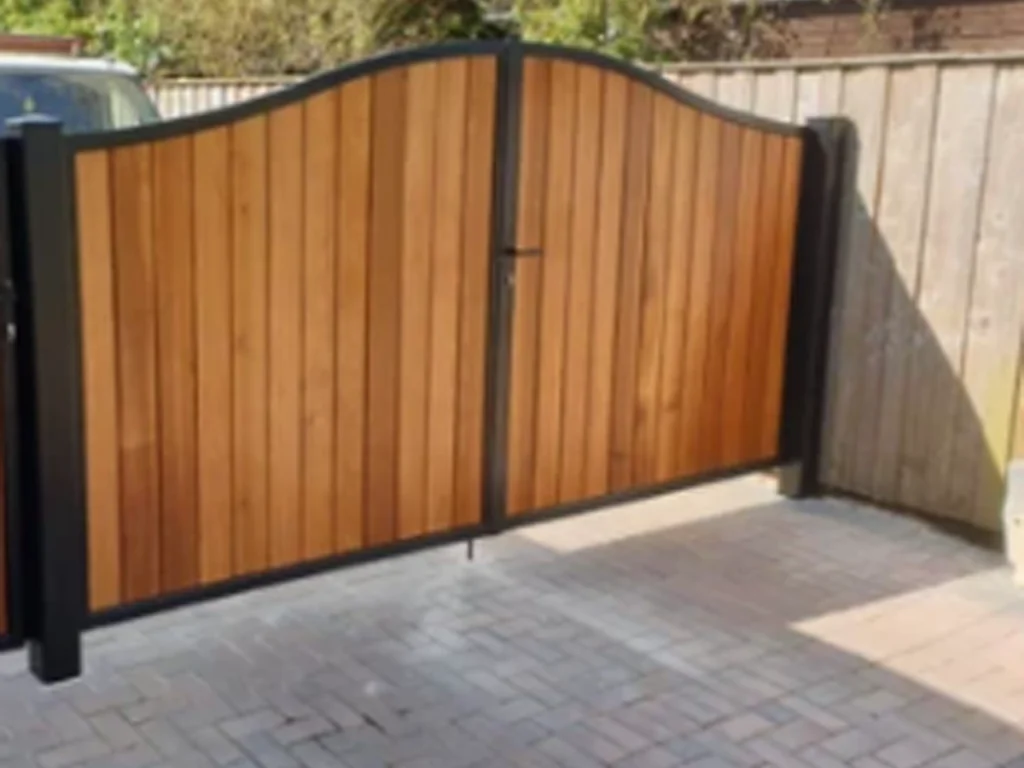
A quality wood gate is more than attractive boards attached to hinges.
The best wooden Gate combines suitable exterior wood, strong framing, dependable posts, correctly sized hardware, proper clearance, practical security, and a design that fits the property.
Each feature supports the others.
For example, premium wood cannot compensate for a weak hinge post. Likewise, strong hinges cannot correct a badly built frame.
Moisture also deserves special attention. The American Wood Council recommends controlling moisture, protecting against decay and insects, using durable or treated materials where appropriate, and maintaining quality construction.
Therefore, Richardson homeowners should judge a wood gate as a complete outdoor system.
The gate should remain supported while moving. It should close without excessive force. The hardware should match the weight. The wood should suit exterior exposure. Water should not remain trapped unnecessarily.
A good design should also serve the property’s actual purpose.
Some homeowners want privacy. Others want security, curb appeal, driveway access, or easier movement between outdoor areas.
The seven features below provide a practical way to evaluate whether a wood gate is built for appearance alone or for dependable daily use.
Quality Wood Gate Features Start With Suitable Exterior Wood
Wood selection is one of the first signs of a well planned gate.
Not every wood species performs the same way outdoors.
Likewise, two boards that look similar can differ in durability, treatment, moisture condition, grade, and intended use.
That is why material choice should begin with exposure.
- A quality gate uses wood suitable for the location and expected weather.
- Exterior components should be selected with moisture and decay risks in mind.
Pressure treatment can also be appropriate for certain exterior components.
However, homeowners should not treat the term pressure treated as a complete specification.
Different preservative systems and use categories exist.
EPA information on wood preservatives explains that modern treated wood products use several preservative chemistries. Most residential uses of older CCA treated lumber ended after 2003.
Therefore, the question should not simply be, “Is this wood treated?”
A better question is, “Is this material suitable for where it will be used?”
Posts exposed to soil and moisture can have different needs from decorative boards located above the ground.
Likewise, a solid privacy gate may require different framing considerations than a lighter open design.
Appearance still matters.
Homeowners may prefer natural grain, a stained finish, painted boards, traditional patterns, or a more modern look.
However, appearance should follow material suitability rather than replace it.
For Richardson homeowners comparing broader gate options, this guide to wood gate installation in Richardson offers another useful planning resource.
The most beautiful board is not automatically the best gate material.
A quality gate starts with wood chosen for both appearance and outdoor service.
A Strong Frame Keeps a Quality Wood Gate in Shape
The visible boards get most of the attention, but the frame does the structural work.
A gate is different from a stationary fence section because it moves.
Every opening transfers forces through the frame, hinges, and supporting post.
Therefore, a weak frame can become a problem even when the wood boards themselves remain attractive.
- A strong frame helps keep the gate square during normal operation.
- Good structural layout transfers the gate load toward its hinges and support.
A poorly framed gate may begin to sag.
The latch side can drop.
Boards may separate.
Joints can loosen.
Eventually, the gate may rub against the ground or fail to meet the latch correctly.
That is why quality wood gate features should include more than decorative boards.
The frame needs enough strength for the width, height, weight, and expected use.
A narrow pedestrian gate and a wide driveway gate create very different structural demands.
The framing method should reflect those differences.
Wood movement also matters.
USDA guidance explains that changes in moisture can create dimensional changes in wood. Those changes may contribute to checking, distortion, or other movement when exterior wood experiences changing conditions.
A sound frame gives the gate a better chance of handling those changes without immediately losing function.
Bracing can also matter.
Its exact form depends on the gate design and construction method.
However, the purpose remains consistent.
The frame should resist deformation as gravity pulls on the free side of the gate.
Homeowners should therefore inspect the gate as a structure.
Look beyond the face boards.
Ask whether the design suits the opening.
Ask how the gate will remain square after repeated use.
Those questions reveal far more about quality than decorative details alone.
Solid Posts and Supports Are Essential Quality Features
A strong gate attached to a weak support is still a weak gate system.
The hinge post carries the moving gate.
Therefore, post condition, placement, material, and installation deserve careful planning.
- Quality support helps maintain alignment as the gate moves.
- A stable hinge post reduces unwanted movement at the point carrying the gate.
Imagine a gate that weighs down one side of a poorly supported post.
At first, everything may look straight.
However, if the post shifts, the entire geometry changes.
The gate may begin to lean.
The latch may sit below its receiver.
The bottom may scrape the surface.
The upper gap may become wider than the lower gap.
The homeowner may think the hinges failed when the deeper problem is support movement.
This is why professional gate planning starts at the ground.
Site conditions should be reviewed before construction.
Soil, slope, drainage, fence alignment, gate width, and nearby structures can all affect the final design.
There is no universal support method that fits every property.
That is also why quality cannot be judged from photographs alone.
Two gates may look identical above ground.
One may have a properly planned support system.
The other may depend on a post that was never intended to carry a moving load.
Richardson homeowners planning an entire fence project can also review these fence installation planning tips for Richardson.
The central point is simple.
A gate depends on its support every second it hangs in the opening.
Therefore, strong support is not an optional feature.
It is one of the foundations of long term performance.
Quality Hinges Latches and Fasteners Support Daily Use
Hardware is another area where quality becomes obvious over time.
A gate may be opened hundreds or thousands of times during its service life.
Each movement places demands on its hinges.
Each closing action involves the latch.
Meanwhile, fasteners hold the structural parts together.
- Hardware should match the size and weight of the gate.
- Exterior fasteners and connectors should be suitable for outdoor conditions and surrounding materials.
A light garden gate does not need exactly the same hinge arrangement as a large privacy gate.
Likewise, a wide driveway gate can place greater demands on supports and hardware.
Expected use matters too.
A gate opened twice a month experiences different service from one used several times every day.
Corrosion also deserves attention.
Outdoor metal connectors face moisture and weather.
Therefore, quality hardware is not just about choosing the thickest hinge in the store.
Compatibility matters.
Placement matters.
Fastening method matters.
The surrounding wood matters.
A quality latch should also be easy for authorized users to operate while still supporting the intended level of security.
For a residential privacy gate, that might mean a dependable mechanical latch.
Other properties may require locks or access control.
The right choice depends on the purpose of the entrance.
Homeowners should test hardware before accepting a new gate.
Open the gate slowly.
Close it several times.
Listen for binding.
Watch whether the latch naturally meets its receiver.
The gate should not need to be lifted by hand just to close.
Good hardware works with the frame rather than compensating for poor construction.
Proper Clearance and Moisture Control Protect Exterior Wood
Water is one of the biggest long term concerns for exterior wood.
A gate cannot avoid rain, humidity, or outdoor air.
However, thoughtful construction can reduce unnecessary moisture exposure.
- A quality wood gate should have practical clearance from surfaces below it.
- Construction details should avoid unnecessary areas where water can remain trapped.
Consider the bottom edge.
If the gate sits directly against wet soil or grass, it may remain damp longer after rain.
Debris can also gather underneath.
If the gate drags, the wood may experience repeated abrasion as well.
Suitable clearance helps the gate move and reduces direct contact with wet surfaces.
The exact clearance depends on the property.
A level walkway differs from a sloped driveway.
A gravel surface behaves differently from concrete.
Therefore, clearance should be planned for the actual site.
Drainage around posts also matters.
Water that consistently collects around supporting wood can create unfavorable conditions.
Durable or treated materials may be needed depending on the exposure.
Finishes can also play a role.
Paints, stains, and water repellent treatments may help protect surfaces when used correctly.
However, coatings are not a substitute for good construction.
A finish cannot solve a gate that constantly rests in standing water.
For Richardson owners, weather planning is especially important because exterior gates face repeated sun, rain, wind, and seasonal changes.
Everlast Gates & Fence discusses related issues in its guide to protecting wood gates from weather in Richardson.
Security and Privacy Should Match the Property
A quality gate should serve a clear purpose.
For many Richardson homeowners, that purpose includes privacy or access control.
A tall solid gate may provide more visual screening.
A more open gate may preserve sight lines.
Neither design is automatically better.
The right choice depends on the property.
- Quality design balances privacy with practical entry needs.
- The latch and closing system should support the intended boundary.
A privacy gate that never closes correctly is not very useful.
Likewise, a secure latch cannot compensate for a frame with large unintended openings or a gate that can easily be pushed out of alignment.
Security therefore depends on the complete assembly.
The gate should close consistently.
The latch should meet correctly.
Hardware should be mounted firmly.
Supporting posts should remain stable.
Homeowners can then add other security measures where needed.
These may include locks, lighting, cameras, intercoms, or electronic access systems.
However, no wood gate should be described as guaranteeing prevention of burglary or trespassing.
A physical gate is one layer.
It helps define and manage an entrance.
It does not eliminate every possible security risk.
Privacy has another practical side.
A completely solid gate can change wind loading compared with an open design.
Therefore, larger solid gates need proper structural planning.
This is one reason a custom design can be valuable.
The builder can consider privacy, gate size, framing, hardware, and the surrounding fence at the same time.
Richardson homeowners interested in design choices can explore how custom fence gates can enhance Richardson properties.
A quality gate should not force homeowners to choose between appearance and function.
Both goals should influence the design from the start.
A Quality Wood Gate Should Be Built for Easy Maintenance
Even an excellent wood gate needs maintenance.
Outdoor materials change.
Finishes wear.
Hardware can loosen.
Ground conditions shift.
Therefore, maintainability is itself a quality feature.
- Important hardware should remain accessible for inspection and adjustment.
- The design should allow homeowners to notice developing problems before they become severe.
A gate should be easy to inspect.
Homeowners should be able to see hinges, latches, fasteners, exposed wood, and the areas around supporting posts.
Warning signs may include unusual movement, loose connections, dragging, peeling finishes, persistent moisture, cracks, or a latch that no longer lines up.
Early attention often makes problems easier to diagnose.
Maintenance also includes surface care.
The right schedule depends on the wood, finish, exposure, and manufacturer recommendations.
Therefore, there is no honest universal rule such as staining every exact number of years.
Instead, homeowners should inspect the surface and follow the product guidance for the coating in use.
Quality construction can also make maintenance simpler.
For example, correctly placed hardware is easier to adjust than hardware installed as a last minute fix.
Suitable clearance makes inspection of the bottom edge easier.
Good drainage allows surfaces to dry.
Strong framing means normal maintenance is less likely to involve repeatedly correcting basic geometry.
The goal is not a maintenance free gate.
Wood is an exterior natural material, so that claim would be unrealistic.
The goal is a gate that can be maintained without continually repairing avoidable installation mistakes.
How Do You Judge Wood Gate Quality Before Buying?
Homeowners should evaluate the complete system instead of focusing only on the wood species.
Start by asking how the gate will be supported.
Then ask about framing.
Next, discuss wood selection, hinges, latch hardware, ground clearance, drainage, and finishing.
- Ask why the proposed materials suit the site.
- Ask how the design handles the gate’s actual size and expected use.
A good contractor should be able to explain those choices in plain language.
You do not need an engineering lecture.
However, answers should make practical sense.
For example, if the gate is unusually wide, the installer should recognize that support and framing become more important.
If the site stays wet after storms, moisture exposure should be part of the discussion.
If privacy is essential, the design should address both visual screening and structural needs.
Owners should also consider how the new gate connects to the existing fence.
A strong gate attached to a failing fence section may still create problems.
The surrounding structure should be inspected before installation.
Why Do Richardson Conditions Matter for a Wood Gate?
Wood reacts to its environment.
That is one reason local conditions matter.
- Exterior wood should be expected to experience changing moisture conditions.
- Good construction should allow for normal environmental exposure rather than assuming the material will never move.
Sunlight affects finishes.
Rain adds moisture.
Warm conditions can accelerate drying.
Repeated changes can affect exterior surfaces over time.
Therefore, a gate designed for an indoor setting would make little sense outside.
Homeowners should select outdoor materials and finishes.
They should also maintain drainage, remove trapped debris, inspect surface coatings, and watch for changing alignment.
The important idea is not that Richardson weather automatically destroys wood gates.
It does not.
Instead, good gates are designed with outdoor exposure already in mind.
Is a More Expensive Wood Gate Always Better?
Price and quality are related only when the extra cost pays for meaningful improvements.
Expensive decorative hardware does not correct poor framing.
Premium boards cannot stabilize a shifting post.
Likewise, the least expensive proposal may omit details that matter later.
- Compare construction details instead of comparing price alone.
- Ask what materials, support, hardware, finish, and installation work are included.
A good proposal should help homeowners understand what they are purchasing.
Custom work may cost more when it requires unusual sizes, heavier framing, premium materials, or special hardware.
However, homeowners should evaluate whether those features actually serve their property.
The best wood gate is not necessarily the most elaborate one.
It is the gate whose design matches its job.
Frequently Asked Questions
What makes a wooden gate high quality?
A high quality wood gate combines suitable exterior wood, a strong frame, stable posts, properly sized hinges, dependable latch hardware, suitable clearance, and careful moisture management. Appearance matters, but structural details determine whether the gate operates well. The American Wood Council also emphasizes moisture control, durable materials, and quality construction for long term wood performance.
What wood is best for an outdoor gate?
There is no single best wood for every gate. The right material depends on outdoor exposure, design, budget, desired appearance, finish, maintenance, and whether treatment is required. Naturally durable or preservative treated materials may be appropriate in some conditions. A professional installer should match the material to its actual location and use.
How can I stop a wood gate from sagging?
Sag prevention starts with a stable hinge post, strong frame, suitable bracing, appropriate gate dimensions, and hardware sized for the load. Correct installation matters from the beginning because adjusting hinges cannot fully correct every structural problem. A gate that begins to drop should be inspected before dragging or latch problems become more severe.
Should a wooden gate have space underneath it?
A wood gate generally needs enough ground clearance to open freely without dragging. The proper amount depends on slope, drainage, surface type, gate movement, and site conditions. Clearance can also reduce unnecessary contact with wet soil, grass, standing water, and debris. The final spacing should be planned for the actual property rather than copied from another gate.
Does pressure treated wood make a gate maintenance free?
No. Pressure treatment can improve resistance to certain biological deterioration, but it does not eliminate every maintenance need. Exterior wood can still weather, move with moisture changes, and require surface care or hardware maintenance. EPA also notes that several different preservative systems are used today, so treatment type and intended use still matter.
Conclusion
The best quality wood gate features work together.
Suitable wood gives the project an appropriate exterior material.
Strong framing helps the gate remain square.
Stable posts support its moving weight.
Good hardware allows dependable opening and closing.
Proper clearance and moisture planning help protect the wood.
Privacy and security features make the gate useful for the property.
Finally, maintainable construction helps homeowners care for the system over time.
None of these features should be judged in isolation.
A premium latch attached to a weak frame is still a poor system.
Beautiful wood mounted on an unstable post will not remain beautiful for long.
Likewise, strong structural work deserves suitable exterior materials.
The American Wood Council summarizes durable wood construction around several connected ideas: control moisture, protect against deterioration, select durable materials, and maintain quality construction. (American Wood Council)
The USDA Wood Handbook also makes clear that moisture affects wood properties and behavior. (Forest Products Lab)
Those principles translate naturally to residential gates.
A wood gate lives outdoors.
It must close into a fixed opening.
It also needs to remain visually attractive beside the fence and home.
Therefore, quality is not one feature.
Quality is how well the wood, frame, posts, hardware, spacing, finish, and design work together.
Richardson homeowners who understand those seven features can make a stronger comparison between gate proposals.
Instead of asking only which gate looks best today, they can ask a better question.
Which gate has been designed to keep working after the first season of use?
That question leads to smarter choices and a more useful entrance.
Choose a Quality Wood Gate for Your Richardson Property
Everlast Gates & Fence can help Richardson homeowners plan wood gates, driveway gates, fence gates, and custom entrances around the property’s actual needs.
At Everlast Gates & Fence, we also offer reliable gate and fence services tailored to residential and commercial properties. Specializing in installing, repairing, and maintaining iron and wood gates and fences along with expert solutions for electric gates, automatic gates, sliding gates, and driveway gates. We also provide professional gate diagnostics, access control systems, customized designs, and comprehensive security enhancements to meet your unique needs and let us ensure your gates are in expert hands so you can enjoy safety, style, and convenience with complete peace of mind.
A thoughtful gate plan should consider design, wood choice, framing, supports, hardware, privacy, clearance, drainage, and expected daily use before construction begins.
Contact us at
Phone : (469) 966-2608
Location: 1106 Commerce Dr, Richardson, TX 75081
Choose a wood gate for more than its appearance. Choose one whose materials and construction work together from the ground up.
